Product Overview
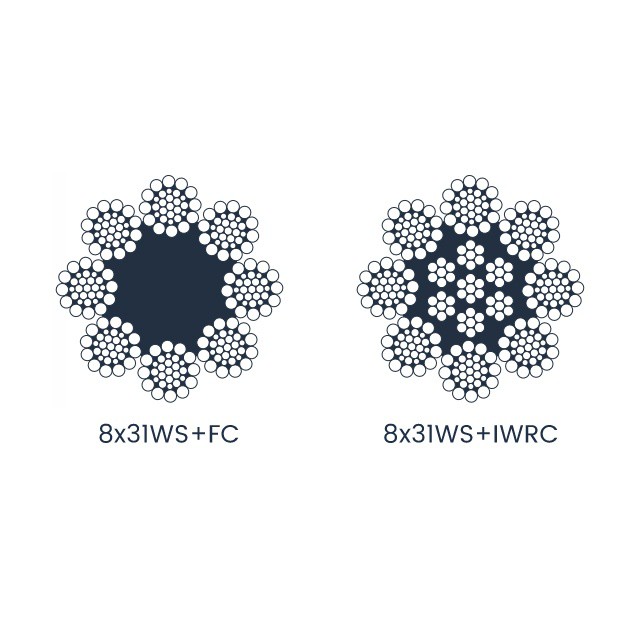
Available with two core options—FC (Fiber Core) and IWRC (Independent Wire Rope Core)—this rope adheres to the strict GB/T20118-2017 standard, ensuring consistent quality, safety, and performance across all use cases. Whether for construction sites, ports, or power plants, the 8×31WS steel wire rope delivers durability and efficiency, addressing the needs of high-intensity industrial environments.
Product Features
High Tensile Strength for Heavy Loads
The 8×31WS steel wire rope’s Warrington Seale strand structure optimizes wire distribution, creating a robust framework that withstands extreme tensile forces. This design ensures the rope can handle heavy loads without compromising structural integrity, making it ideal for tasks like lifting heavy machinery or hauling large cargo. Its tensile strength performance is further enhanced by high-quality steel materials, which resist stretching and deformation even under prolonged use.
Flexible & Durable Core Options
Two core types cater to diverse application needs:
FC (Fiber Core): Crafted from strong, resilient fibers, this core offers excellent flexibility, allowing the rope to bend smoothly around pulleys and drums. It’s perfect for general lifting tasks where maneuverability is key, such as light to medium hoisting in construction.
IWRC (Independent Wire Rope Core): Made from a separate wire rope, this core boosts the rope’s overall strength and shock load resistance. It’s specifically designed for harsh conditions where sudden impacts or heavy, repetitive loads are common—like dragging heavy equipment or lifting in industrial settings.
Wear & Corrosion Resistance
The 8×31WS steel wire rope uses high-grade steel wires treated to resist wear and corrosion. This treatment protects the rope from environmental factors like moisture, dust, and chemical exposure, extending its service life in outdoor or humid environments (e.g., port operations or outdoor construction sites). The wear-resistant steel wires also reduce friction damage, ensuring consistent performance even with frequent use.
Compliance with Global Industry Standards
Adherence to the GB/T20118-2017 standard means the 8×31WS steel wire rope meets international quality and safety benchmarks. This compliance is critical for industries like power generation and infrastructure, where non-compliant equipment can lead to safety risks or project delays. Customers can trust that this rope aligns with strict operational requirements, minimizing downtime and liability.
Nominal
Dlameter
(mm) | Approx Weight(kg/100m) | Nominal Tensile Strength(MPa) |
| 1570 | 1670 | 1770 | 1870 | 1960 | 2160 |
| Minimum Breaking Strength(kn) |
| NF | SF | IWR
iws | FC | IWR
iwS | FC | IWR
iws | FC | IWR
iwS | FC | IWR
iws | FC | IWR
IWS | FC | IWR
iwS |
| 14 | 70.0 | 67.4 | 85.3 | 90.2 | 106 | 95.9 | 113 | 102 | 120 | 107 | 127 | 113 | 133 | 124 | 146 |
| 16 | 91.4 | 68.1 | 111 | 118 | 139 | 125 | 148 | 133 | 157 | 140 | 166 | 147 | 174 | 162 | 191 |
| 18 | 116 | 111 | 141 | 149 | 176 | 159 | 187 | 168 | 198 | 178 | 210 | 186 | 220 | 205 | 242 |
| 20 | 143 | 138 | 174 | 184 | 217 | 196 | 231 | 207 | 245 | 219 | 259 | 230 | 271 | 253 | 299 |
| 22 | 173 | 166 | 211 | 223 | 263 | 237 | 280 | 251 | 296 | 265 | 313 | 278 | 328 | 306 | 362 |
| 24 | 206 | 198 | 251 | 265 | 313 | 282 | 333 | 299 | 353 | 316 | 373 | 331 | 391 | 365 | 430 |
| 26 | 241 | 233 | 294 | 311 | 367 | 331 | 391 | 351 | 414 | 370 | 437 | 388 | 458 | 428 | 505 |
| 28 | 280 | 270 | 341 | 361 | 426 | 384 | 453 | 407 | 480 | 430 | 507 | 450 | 532 | 496 | 586 |
| 30 | 321 | 310 | 392 | 414 | 489 | 440 | 520 | 467 | 551 | 493 | 582 | 517 | 610 | 570 | 673 |
| 32 | 366 | 352 | 445 | 471 | 556 | 501 | 592 | 531 | 627 | 561 | 663 | 588 | 694 | 648 | 765 |
| 34 | 413 | 398 | 503 | 532 | 628 | 566 | 668 | 600 | 708 | 633 | 748 | 664 | 784 | 732 | 864 |
| 36 | 463 | 446 | 564 | 596 | 704 | 634 | 749 | 672 | 794 | 710 | 839 | 744 | 879 | 820 | 969 |
| 38 | 516 | 497 | 628 | 664 | 784 | 707 | 834 | 749 | 884 | 791 | 934 | 829 | 979 | 914 | 1080 |
| 40 | 571 | 550 | 696 | 736 | 869 | 783 | 925 | 830 | 980 | 877 | 1040 | 919 | 1090 | 1010 | 1230 |
| 42 | 630 | 607 | 767 | 811 | 958 | 863 | 1020 | 915 | 1080 | 967 | 1140 | 1010 | 1200 | 1120 | 1320 |
● Standard: GB/T20118-2017
● For various equipment of lfting, hoisting and dragging, the rope with steel core may be used under the shock load.
Applications
Construction & Heavy Lifting
Contractors rely on the 8×31WS steel wire rope for lifting tasks involving cranes, tower cranes, and mobile hoists. Its high tensile strength and flexibility make it suitable for moving steel beams, concrete blocks, and heavy machinery on construction sites. The FC core option is often used for medium-load tasks like lifting prefabricated components, while the IWRC core handles heavier loads such as excavators or steel structures.
Port & Logistics Operations
Ports and logistics centers use the 8×31WS steel wire rope for cargo handling, including loading and unloading containers from ships or trucks. Its corrosion resistance stands up to saltwater and coastal humidity, and its durability ensures it can withstand the frequent, repetitive motion of port cranes. The IWRC core’s shock load resistance is particularly valuable here, as it absorbs sudden forces from shifting cargo.
Power Generation Projects
In nuclear, thermal, and hydroelectric power plants, the 8×31WS steel wire rope is used for installing heavy equipment like turbines, generators, and transformers. Its compliance with industry standards and resistance to harsh conditions (e.g., high temperatures or chemical exposure) make it a safe choice for these critical operations. The rope’s reliability also reduces the risk of equipment failure during sensitive installation processes.
Infrastructure Development
For high-speed rail, bridge, and tunnel construction, the 8×31WS steel wire rope supports tasks like lifting bridge segments or securing tunnel liners. Its flexibility allows it to adapt to complex lifting angles, while its strength ensures stability when working with large, irregularly shaped loads. The rope’s durability also makes it suitable for long-term infrastructure projects, where equipment must perform consistently over months or years.
FAQ
What’s the difference between FC and IWRC cores in 8×31WS steel wire rope?
The FC (Fiber Core) prioritizes flexibility, making it ideal for tasks that require bending around pulleys (e.g., light hoisting). The IWRC (Independent Wire Rope Core) focuses on strength and shock load resistance, suiting heavy-duty or high-impact applications (e.g., dragging equipment). Choose FC for maneuverability and IWRC for durability in harsh conditions.
Can 8×31WS steel wire rope be used for shock load applications?
Yes—specifically the IWRC core variant. The IWRC (Independent Wire Rope Core) enhances the rope’s ability to absorb sudden impacts, making it safe for shock load scenarios like lifting heavy objects that may shift or sudden load changes in industrial settings. The FC core is not recommended for heavy shock load use.
Is 8×31WS steel wire rope suitable for outdoor long-term use?
Absolutely. Its corrosion-resistant steel wires and protective treatment shield it from moisture, salt, and dust—common outdoor hazards. This makes it ideal for outdoor construction, port operations, or any application where the rope is exposed to the elements for extended periods.
What industries commonly use 8×31WS steel wire rope?
Key industries include construction (heavy lifting), port logistics (cargo handling), power generation (equipment installation), and infrastructure (high-speed rail, bridges). Its versatility, strength, and compliance with standards make it a go-to choice for any sector requiring reliable lifting or hoisting solutions.


