Product Overview
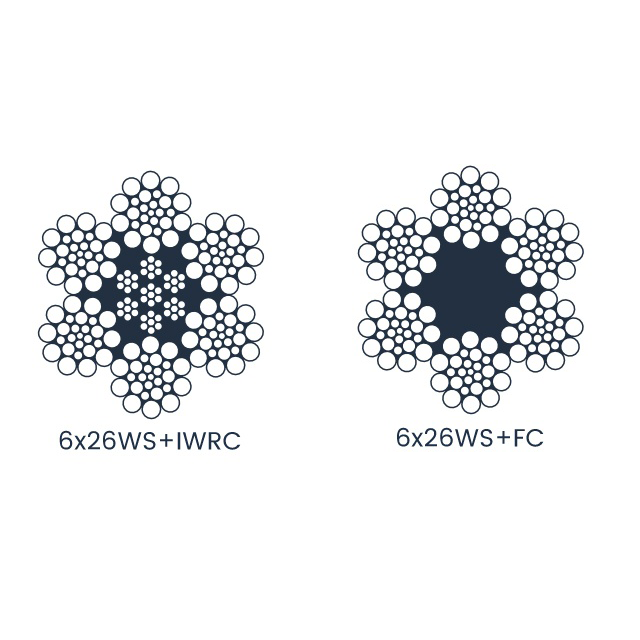
A popular variant, the 6×26WS+IWR Steel Wire Rope (with an Independent Wire Rope Core, IWR), further enhances durability, making it suitable for harsh environments like construction sites and marine operations. Compliant with global industrial standards, the 6×26WS Steel Wire Rope is trusted for its reliability in sectors spanning construction, shipping, and infrastructure development.
Product Features
Enhanced Flexibility & Fatigue Resistance
The Warrington-Seale (WS) pattern of the 6×26WS Steel Wire Rope allows greater flexibility compared to traditional 6-strand ropes. This flexibility reduces fatigue during repeated bending—critical for applications like excavator arms and large-scale pouring cranes, where the rope is constantly curved and straightened. Even with high-frequency use, the rope maintains structural integrity, minimizing premature failure risks.
High Load-Bearing Capacity with IWR Core
The 6×26WS+IWR Steel Wire Rope features an independent wire rope core that boosts tensile strength and load capacity. Unlike fiber cores, the IWR core resists crushing and deformation under heavy loads, making the rope suitable for lifting large concrete blocks, heavy machinery, and shipping containers. This blend of flexibility and strength sets it apart from rigid, low-flexibility heavy-duty ropes.
Superior Abrasion Resistance
Each wire in the 6×26WS Steel Wire Rope is coated with a wear-resistant layer, enabling it to withstand friction from pulleys, hooks, and rough surfaces. This makes the rope ideal for construction machinery (e.g., steel movers) and marine operations (e.g., towboat towing), where constant contact with hard materials is unavoidable.
Weather & Chemical Resistance
The 6×26WS Steel Wire Rope is designed to resist harsh environmental conditions, including saltwater, humidity, and industrial chemicals. This corrosion resistance makes it a top choice for marine applications like shipping loading/unloading and wreck salvage, where saltwater exposure degrades lesser ropes.
Reliable Structural Stability
The 6-strand, 26-wire WS pattern ensures uniform load distribution across the 6×26WS Steel Wire Rope. Each strand’s tight wire packing prevents individual wires from slipping or bearing excessive stress, even under uneven loads. This stability enhances operational safety and extends the rope’s lifespan, reducing maintenance costs.
Adaptability to High-Frequency Use
Unlike rigid ropes that degrade quickly with repeated use, the 6×26WS Steel Wire Rope thrives in high-frequency hoisting and conveying tasks. Its flexibility allows it to adapt to pulley systems of various sizes, making it suitable for pouring cranes, timber floating operations, and continuous material handling in factories.
Specification: DIN/EN/ISO/JISG/BS
6x26WS+FC,6x26WS+IWRC |
Nominal
Diameter
(mm) | Approx Weight(kg/100m) | Nominal Tensile Strength(MPa) |
| 1770 | 1960 |
| Minimum Breaking Strength(kn) |
| FC | IWRC | FC | IWRC | FC | IWRC |
| 8 | 24.3 | 26.8 | 37.4 | 40.3 | 41.4 | 44.7 |
| 10 | 38.0 | 41.8 | 58.4 | 63.0 | 64.7 | 69.8 |
| 12 | 54.7 | 60.2 | 84.1 | 90.7 | 93.1 | 100 |
| 13 | 64.2 | 70.6 | 98.7 | 106 | 109 | 118 |
| 14 | 74.5 | 81.9 | 114 | 124 | 127 | 137 |
| 16 | 97.3 | 107 | 150 | 161 | 166 | 179 |
| 18 | 123 | 135 | 189 | 204 | 210 | 226 |
| 20 | 152 | 167 | 234 | 252 | 259 | 279 |
| 22 | 184 | 202 | 283 | 305 | 313 | 338 |
| 24 | 219 | 241 | 336 | 363 | 373 | 402 |
| 26 | 257 | 283 | 395 | 426 | 437 | 472 |
| 28 | 298 | 328 | 458 | 494 | 507 | 547 |
| 30 | 342 | 376 | 526 | 567 | 582 | 628 |
| 32 | 389 | 428 | 598 | 645 | 662 | 715 |
| 34 | 439 | 483 | 675 | 728 | 748 | 807 |
| 36 | 492 | 542 | 757 | 817 | 838 | 904 |
| 38 | 549 | 604 | 843 | 910 | 934 | 1010 |
| 40 | 608 | 669 | 935 | 1010 | 1030 | 1120 |
| 42 | 670 | 737 | 1030 | 1110 | 1140 | 1230 |
| 44 | 736 | 809 | 1130 | 1220 | 1250 | 1350 |
| Note: Stainless Steel Wire Rope is available. |
● Standard: GB/T20118-2017
● For port loading and unloading and construction purposes, for fower crane purposes.
Applications
Construction Machinery & Infrastructure
The 6×26WS Steel Wire Rope is widely used in construction equipment like excavators and large-scale pouring cranes. Its flexibility allows movement with the machinery’s arms, while the 6×26WS+IWR Steel Wire Rope variant handles heavy loads of concrete, steel beams, and construction materials. It is also used in vertical shaft lifting and inclined slope hoisting for tunnels, bridges, and other infrastructure projects.
Marine Operations
In shipping and offshore industries, the 6×26WS Steel Wire Rope excels in shipping loading/unloading, towboat operations, and wreck salvage. Its corrosion resistance withstands saltwater, while its strength ensures safe lifting of heavy cargo or damaged vessels. The rope’s flexibility also simplifies handling in tight spaces on ships and docks.
Industrial Lifting & Metallurgy
For metallurgical and manufacturing plants, the rope is used in blast furnace winching and steel mover operations. Its wear resistance handles high temperatures and abrasive materials in furnace environments, while its load capacity supports lifting steel coils and raw materials. It is also suitable for timber floating, where it drags logs through water without degrading.
General Heavy-Duty Hoisting
Beyond specialized sectors, the 6×26WS Steel Wire Rope is a go-to for general hoisting tasks like goods net lifting in warehouses and ports. Its versatility—combining flexibility, strength, and durability—makes it suitable for a wide range of non-specialized heavy-duty applications.
FAQ
What makes 6×26WS steel wire rope different from other 6-strand ropes?
The 6×26WS Steel Wire Rope uses a Warrington-Seale (WS) pattern (26 wires per strand with mixed small/large wires), offering better flexibility than Seale-only ropes and higher strength than Warrington-only designs. This balance is perfect for applications needing both frequent bending and heavy loads.
Is 6×26WS steel wire rope suitable for marine salvage operations?
Yes, the 6×26WS Steel Wire Rope (especially the 6×26WS+IWR Steel Wire Rope variant) is excellent for marine salvage. Its corrosion resistance withstands saltwater, and its strength/flexibility allow safe lifting of damaged ships or cargo in harsh offshore conditions.
What core type is common for 6×26WS steel wire rope, and why?
The 6×26WS+IWR Steel Wire Rope (independent wire rope core) is most common. The IWR core enhances strength and crush resistance, complementing the rope’s flexibility—critical for heavy-duty tasks like construction hoisting and marine use. Fiber cores are available for lighter loads but are less common for this rope’s typical applications.
Can 6×26WS steel wire rope handle heavy loads in high-frequency hoisting?
Absolutely. Its WS structure reduces fatigue from repeated bending, while the IWR core (in 6×26WS+IWR Steel Wire Rope) provides strength for heavy loads—making it ideal for high-frequency tasks like pouring crane operations and excavator lifting.
Does 6×26WS steel wire rope require special installation?
No specialized tools are needed, but align the 6×26WS Steel Wire Rope with compatible pulley sizes (to preserve flexibility) and avoid kinking during installation. Regular lubrication after installation also maintains wear/corrosion resistance, extending service life.


