Product Overview
The rope is available with two core options: FC (Fiber Core) and IWRC (Independent Wire Rope Core), allowing it to adapt to varying load requirements and environmental conditions. Compliant with global standards like GB/T20118-2017, DIN/EN/ISO, and JISG/BS, the 6×36WS Steel Wire Rope is a trusted solution for construction, port loading, and heavy lifting tasks worldwide.
Product Features
Warrington Seale (WS) Structure for Enhanced Strength
The Warrington Seale (WS) pattern in the 6×36 strand configuration is a key advantage: it combines large and small wires within each strand to increase wire count without expanding strand diameter. This dense packing significantly improves the rope’s tensile strength and breaking strength, enabling it to handle heavier loads than standard rope designs. Additionally, the WS structure reduces contact stress between wires, minimizing fatigue and extending service life—critical for applications with repeated lifting cycles, such as tower crane operations.
Dual Core Options for Targeted Performance
The 6×36WS Steel Wire Rope offers two core choices to match specific needs:
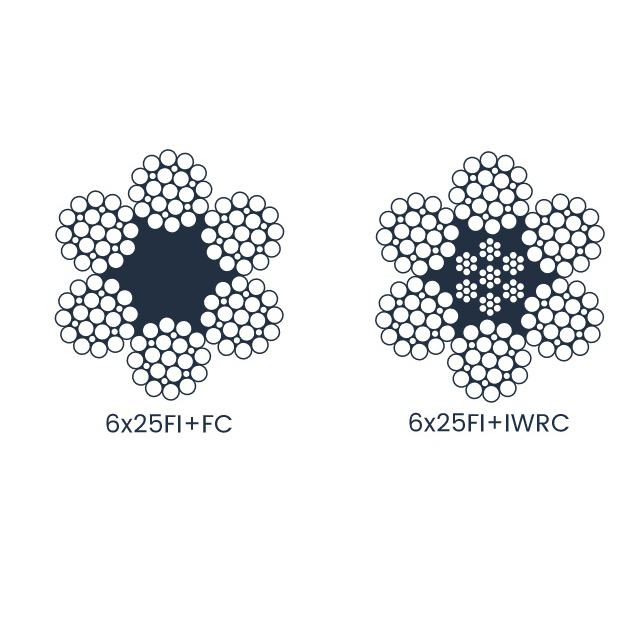
FC (Fiber Core): Ideal for applications requiring higher flexibility, such as portable lifting equipment or tasks where the rope needs to bend around small pulleys. The fiber core also acts as a lubricant reservoir, reducing friction between wires and enhancing durability.
IWRC (Independent Wire Rope Core): Built for heavy-duty loads and harsh environments. The steel core adds extra rigidity and tensile strength, making it suitable for tower cranes, port cargo handling, and construction projects. It also resists crushing, a common issue in high-pressure lifting scenarios.
Corrosion-Resistant Variants
For outdoor or marine use, the 6×36WS Steel Wire Rope is available as stainless steel wire rope or galvanized steel variants. Both options provide excellent resistance to rust and corrosion, ensuring performance in rain, humidity, or saltwater. The base steel material is selected for its high carbon content, further enhancing durability against impact and abrasion—key for rough industrial settings.
Consistent Global Performance
Compliance with GB/T20118-2017, DIN/EN/ISO, and JISG/BS standards guarantees the 6×36WS Steel Wire Rope meets strict quality requirements across regions. This standardization ensures uniform dimensions and strength metrics, making it easy to integrate into international projects—whether used with European-made cranes or Asian port equipment, the rope performs reliably.
Specification: DIN/EN/ISO/JISG/BS
6x36WS+FC, 6x36WS+IWRC |
Nominal
Diameter
(mm) | ApproxWeight(kg/100m) | Nominal Tensile Strength(MPa) |
| 1770 | 1960 |
| Minimum Breaking Strength(kn) |
| FC | IWRC | FC | IWRC | FC | IWRC |
| 8 | 24.3 | 26.8 | 37.4 | 40.3 | 41.4 | 44.7 |
| 10 | 38 | 41.8 | 58.4 | 63 | 64.7 | 69.8 |
| 12 | 54.7 | 60.2 | 84 | 89.9 | 95.9 | 93.1 |
| 13 | 64.3 | 70.7 | 98.3 | 106 | 109 | 118 |
| 14 | 74.5 | 82 | 114 | 124 | 127 | 137 |
| 16 | 97.3 | 107 | 149 | 161 | 166 | 179 |
| 18 | 123 | 135 | 189 | 204 | 210 | 226 |
| 20 | 152 | 167 | 233 | 252 | 259 | 279 |
| 22 | 184 | 202 | 282 | 304 | 313 | 338 |
| 24 | 219 | 241 | 336 | 362 | 373 | 402 |
| 26 | 257 | 283 | 394 | 425 | 437 | 472 |
| 28 | 298 | 328 | 457 | 493 | 507 | 547 |
| 30 | 342 | 376 | 525 | 567 | 582 | 628 |
| 32 | 389 | 428 | 598 | 644 | 662 | 715 |
| 34 | 439 | 483 | 675 | 728 | 748 | 807 |
| 36 | 493 | 542 | 756 | 816 | 838 | 904 |
| Note: Stainless Steel Wire Rope is available. |
● Standard: GB/T20118-2017
● For port loading and unloading and construction purposes, for tower crane purposes.
Applications
The 6×36WS Steel Wire Rope is built for heavy-duty scenarios, excelling in the following applications:
Port Loading & Unloading: With its high breaking strength and optional IWRC core, the rope handles containers, bulk cargo, and heavy machinery in ports. The stainless steel wire rope or galvanized variant resists saltwater corrosion, ensuring long-term use in marine environments.
Construction & Tower Crane Operations: Tower cranes rely on the rope’s tensile strength and fatigue resistance to lift steel beams, concrete blocks, and other heavy materials. The 6×36WS+IWRC variant is preferred here for its ability to support repeated heavy loads without deformation.
Heavy Industrial Lifting: In factories or manufacturing plants, the rope lifts large equipment (such as generators or machine parts). The FC core variant suits indoor tasks needing flexibility, while the IWRC variant handles outdoor heavy loads.
Infrastructure Projects: During bridge or highway construction, the 6×36WS Steel Wire Rope secures structural components and assists in cable installation. Its durability against weathering makes it a reliable choice for long-term infrastructure work.
FAQ
What is the difference between 6×36WS+FC and 6×36WS+IWRC?
The main difference is the core type: FC (Fiber Core) offers greater flexibility, making it ideal for tasks with frequent bending (e.g., portable lifts). It also holds lubricant to reduce wear. IWRC (Independent Wire Rope Core) is a steel core that adds extra tensile strength and rigidity, suited for heavy-duty tasks like tower crane lifting or port cargo handling. Choose FC for flexibility; IWRC for maximum load capacity.
Is the 6×36WS Steel Wire Rope suitable for coastal construction projects?
Yes, especially if you select the stainless steel wire rope or galvanized variant. Coastal environments expose equipment to saltwater and high humidity, which can cause rust in standard steel. The corrosion-resistant variants protect the 6×36WS Steel Wire Rope from degradation, ensuring it performs reliably throughout coastal construction projects.
Can the 6×36WS Steel Wire Rope be used with all types of cranes?
The 6×36WS Steel Wire Rope is compatible with most industrial cranes, but the core type matters: 6×36WS+IWRC works best with tower cranes and heavy-duty mobile cranes (for lifting large loads). 6×36WS+FC is better for smaller cranes or portable lifts that require flexibility. Always check your crane’s specifications to ensure the rope’s breaking strength matches the crane’s load capacity.
How often should I inspect the 6×36WS Steel Wire Rope?
Inspect the rope before each use for signs of wear, such as frayed wires, core damage, or corrosion. For heavy-duty applications (like daily tower crane use), conduct a detailed inspection weekly—clean the rope, check for kinks, and verify that the tensile strength hasn’t been compromised. Replace the rope immediately if any damage is found to avoid safety risks.


