Specification:RR-W-410D
Improved Plow Steel(lPS)
6x7+FC |
| Rope Diameter | Approx Weight | Nominal Tensile Strength(MPa) |
| Rope Diameter | Maximum | b/1000' |
kg/1000' | Ungalv | Galvanized |
| in | in | Ib | Ib |
| 1/4 | 0.265 | 97 | 44 | 5280 | 4760 |
| 5/16 | 0.328 | 151 | 69 | 8200 | 7380 |
| 3/8 | 0.394 | 218 | 99 | 11720 | 10540 |
| 7/16 | 0.459 | 296 | 134 | 15860 | 14280 |
| 1/2 | 0.525 | 387 | 176 | 20600 | 18540 |
| 9/16 | 0.591 | 490 | 222 | 26000 | 23400 |
| 5/8 | 0.656 | 605 | 274 | 31800 | 28600 |
| 3/4 | 0.788 | 670 | 395 | 45400 | 40800 |
| Note: Stainless Steel Wire Rope is available. |
Product Overview
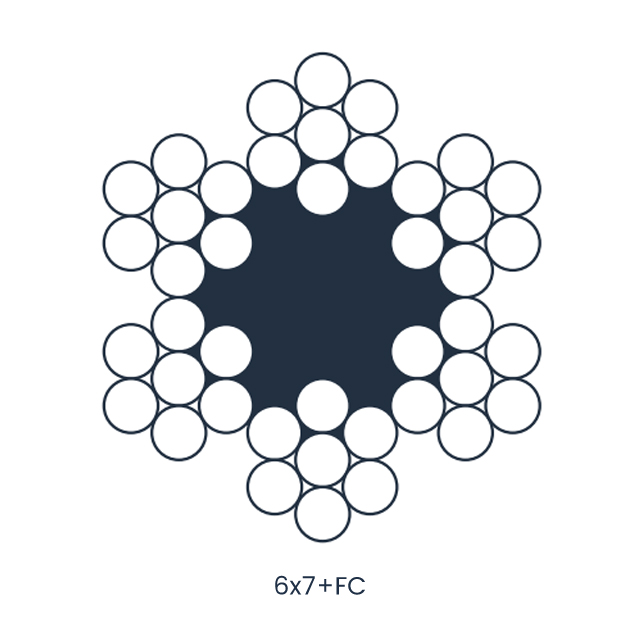
Its straightforward design features 6 strands each containing 7 high-tensile steel wires wrapped around a central Fiber Core (FC), available in diameters from 3.0mm to 32mm . This configuration delivers a balance of strength, flexibility, and economy, making it a staple in industries ranging from oil and gas to agriculture. The fiber core, typically constructed from natural sisal or synthetic polypropylene, provides essential cushioning and support to the outer strands .
Product Features
Balanced Strength-to-Flexibility Ratio
The 6x7 structure achieves tensile strengths between 1,270N/mm² and 1,770N/mm², with minimum breaking forces ranging from 6,370N for 3mm diameter to 73,000N for larger sizes . This balance makes it flexible enough for spooling on winch drums while maintaining the strength required for heavy-duty applications.
Fiber Core Advantages
The FC core absorbs shocks during sudden load changes, reducing stress on the outer strands and extending service life. It also retains lubrication within the rope structure, minimizing internal friction and wear during operation . Unlike steel cores, the fiber core offers some degree of moisture absorption, helping to regulate internal humidity in varying environmental conditions.
Corrosion Resistance Options
Available with galvanized or ungalvanized finishes. Hot-dipped galvanized versions provide enhanced protection against rust and corrosion, making them suitable for outdoor and marine applications, while ungalvanized ropes offer superior flexibility for indoor applications .
Applications
Oil and Gas Drilling
Known industry-wide as "sand lines," these ropes are essential for well drilling operations, including coring, swabbing, and casing lowering . The fiber core design handles the continuous flexing and heavy loads encountered in drilling rig operations.
Agricultural and Forestry Machinery
Used in tractor winches, hay balers, and logging equipment. The rope’s flexibility allows for easy handling in outdoor environments, while its strength reliably secures and transports agricultural products and timber.
General Industrial Winching
Integral to utility winches, garage hoists, and material handling systems in workshops and warehouses. The 6x7+FC configuration provides the necessary durability for daily use while remaining economical enough for general-purpose applications.
FAQ
How does the FC core affect weight capacity?
The Fiber Core reduces overall weight compared to steel cores while maintaining adequate strength for most industrial applications. It allows for a 5-10% higher flex life due to better shock absorption, though maximum breaking force is slightly lower than steel-core alternatives of the same diameter .
What lubrication is recommended?
Use petroleum-based wire rope lubricants containing corrosion inhibitors. Apply liberally after cleaning, ensuring penetration into the core through the interstrand gaps. Re-lubricate every 3 months or 100 hours of operation, whichever comes first.
What causes "birdcaging" and how to prevent it?
Birdcaging (strand separation) occurs from sudden load release or improper spooling. Prevent it by avoiding shock loads, maintaining proper tension during spooling, and ensuring drum alignment matches the rope’s lay direction.
Is this rope suitable for overhead lifting of personnel?
No, the 6x7+FC design is not recommended for personnel lifting. It lacks the redundant safety features required for such applications, which typically demand more complex constructions with higher safety factors.


