Navigating the market for industrial lifting equipment often presents a confusing paradox. Buyers frequently encounter vast price disparities where one reel commands $1.50 per foot while another, seemingly similar product, costs upwards of $50 per foot. This gap is not arbitrary; it reflects deep differences in metallurgy, engineering precision, and safety assurance. For procurement managers and project engineers, the temptation to accept the "low bid" is strong, yet selecting steel wire rope based solely on the lowest upfront quote often introduces significant operational risks. Cheap alternatives may lead to frequent downtime, accelerated wear, or catastrophic safety failures that far exceed the initial savings.
Understanding the true value of lifting gear requires deconstructing the pricing model into three distinct layers: raw materials, engineering complexity, and the "hidden" costs of compliance. A rope designed for static guying does not require the same fatigue resistance as a hoist line on an offshore rig, and their price tags will reflect this difference. This guide explores the specific factors that influence cost, helping buyers distinguish between unnecessary markups and essential value. By analyzing these variables, you can make data-driven decisions that balance budget constraints with operational safety.
Key Takeaways
Material Drives Baselines: Stainless steel (especially 316 grade) and specialized alloys dictate the minimum price floor compared to high-carbon steel.
Complexity Adds Value: Non-rotating and compact strand steel wire rope command premiums due to intricate manufacturing and higher fatigue resistance.
Compliance is Not Optional: Certified ropes (API, DNV, ISO) carry higher costs due to rigorous testing and traceability, essential for regulated industries.
TCO Over Sticker Price: A 30% higher upfront cost for galvanized or coated ropes can reduce replacement frequency by 50%, lowering Total Cost of Ownership.
Raw Material Composition and Grade Specifications
The foundation of any pricing model begins with the metal itself. Before a single wire is drawn, global commodities markets influence the base cost of production. Understanding these material variables helps explain why price quotes fluctuate week over week.
Alloy Market Fluctuations
Finished rope prices maintain a direct correlation with indices from the London Metal Exchange (LME). The cost of iron ore and energy sets the baseline for carbon steel, but the volatility increases significantly with specialized alloys. Ropes requiring high resistance to corrosion rely heavily on Nickel and Chromium.
When reviewing steel wire rope specifications, you will notice that products requiring high alloy content—such as Stainless 316 for marine environments—are subject to "alloy surcharges." Unlike standard carbon steel, which has a relatively stable pricing structure, stainless variants fluctuate based on the immediate availability of Nickel. Manufacturers often pass these raw material surcharges directly to the buyer, meaning a quote valid today might change next month based purely on commodity trading.
Core Type Economics
The inner heart of the rope, known as the core, plays a pivotal role in both performance and price. The material selection here changes the weight, strength, and manufacturing cost.
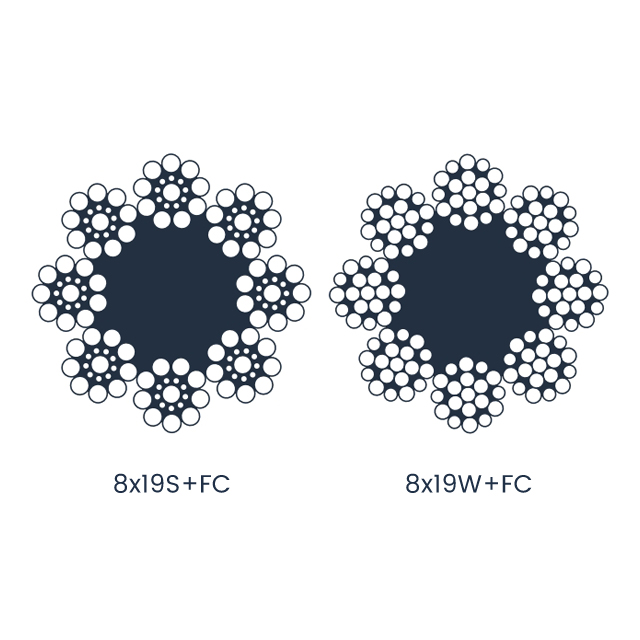
FC (Fiber Core): Ropes featuring a core made of polypropylene or natural fibers are generally lower in cost. They offer greater flexibility and hold lubrication well but lack the structural support necessary for heavy crushing loads.
IWRC (Independent Wire Rope Core): This construction utilizes a smaller steel rope as the core. The higher volume of steel increases the weight per foot and the manufacturing cost. However, it provides essential structural stability, higher breaking strength, and resistance to crushing on drums.
WSC (Wire Strand Core): Often found in smaller diameter ropes, this uses a single wire strand as the core. It serves as an intermediate cost option between fiber and independent rope cores.
The Cost of Corrosion Resistance
Environmental protection is a major cost driver. A rope destined for a climate-controlled warehouse has different needs than one installed on a deep-sea trawler.
| Finish Type | Relative Cost | Primary Application | Cost Justification |
| Bright (Uncoated) | Low | Indoor cranes, elevators (dry) | Minimal processing; relies on lubricant for protection. |
| Galvanized (Zinc) | Medium | Construction, shipping, outdoor | Zinc plating process adds time and material cost; price varies by coating thickness (Class A vs. Class B). |
| Stainless Steel | High | Marine, food processing, yachting | Inherent alloy cost; typically 20–30% premium over carbon steel due to difficulty in machining and raw material price. |
Construction Complexity: Standard vs. High-Performance Ropes
Beyond the raw material, the geometry of how wires are stranded together determines the final price. Manufacturing simple, general-purpose ropes is a streamlined process, whereas engineering high-performance ropes requires slower production speeds and specialized machinery.
Standard Constructions
Classifications like 6x19 or 6x36 are the workhorses of the industry. These standard constructions are mass-produced globally, leading to highly competitive pricing. They are suitable for general-purpose lifting where fatigue cycles are low to moderate. Because the manufacturing technology is widely available, the price differential between suppliers is often minimal, driven mostly by logistics and brand reputation.
Performance-Engineered Ropes
When applications demand higher breaking loads or resistance to rotational forces, standard constructions fall short. Specialized designs involve additional processing steps that increase the unit cost.
Compact Strand Technology
In this process, the strands are drawn through a die or rolled to compress the outer wires before the rope is closed. This flattens the surface and reduces void spaces within the rope. A compact strand steel wire rope commands a premium because the manufacturing consumes more energy and takes more time. However, the value proposition is clear: users gain a higher metallic cross-section area, resulting in greater breaking strength for the same diameter, along with significantly improved resistance to abrasion and drum crushing.
Rotation-Resistant Designs
Standard ropes have a natural tendency to unlay under load, which causes the load to spin if not guided. For single-part line lifting, such as on tower cranes, this is dangerous. A non-rotating steel wire rope utilizes a complex construction where inner and outer layers of strands are laid in opposite directions. Under tension, the torque from the layers cancels each other out. Producing these ropes requires specialized planetary stranding machines and slower production speeds to ensure precise geometric balance, justifying the significantly higher price point.
Post-Processing Treatments
The manufacturing journey does not always end at the closing machine. Additional treatments can further elevate the steel wire rope cost. Pre-stretching removes the constructional stretch, ensuring the rope is stable immediately upon installation. Plastic impregnation (EPIWRC), where a polymer is injected between the core and outer strands, cushions the internal contact points. These steps add labor, energy, and material costs but are critical for extending service life in high-fatigue environments.
The "Hidden" Costs: Compliance, Testing, and Certification
In safety-critical industries, you are paying for certainty. A significant portion of the price tag on premium wire rope funds the quality assurance ecosystem that validates the product's reliability.
Verification vs. Assumption
Inexpensive rope found in general hardware channels often lacks traceability. If a failure occurs, there is no way to track the batch back to the raw material heat number. Premium pricing includes the administrative "paper trail," specifically the Mill Test Certificates (MTC) and Certificates of Conformity. These documents prove that the rope meets the stated breaking load and chemical composition requirements.
Testing Rigor
Manufacturers must prove their product works, and testing is expensive.
Destructive Testing: To verify Minimum Breaking Load (MBL), manufacturers must cut a segment of the finished rope and pull it to destruction. This "sacrificial" cost is amortized into the price of the sold product.
Non-Destructive Testing (NDT): For critical infrastructure, Magnetic Rope Testing (MRT) may be used to scan for internal broken wires or flaws without damaging the rope.
Fatigue & Torsion Testing: High-stakes applications like mining and elevators require ropes to undergo millions of bending cycles in test labs. Funding these long-term validation studies is part of the overhead for top-tier manufacturers.
Third-Party Approvals
Self-declaration of quality is rarely enough for regulated sectors. Manufacturers pay substantial fees to maintain approvals from bodies like the American Petroleum Institute (API), DNV (for marine), or ISO standards organizations. The decision point for the buyer is risk management: for non-critical agricultural use, generic standards may suffice. However, for overhead lifting or personnel transport, certified compliance is a non-negotiable insurance cost that is reflected in the purchase price.
Supply Chain Variables: Logistics, Inventory, and Customization
The physical journey of the rope from factory to site introduces variable costs that can exceed the value of the material itself.
The "Cost of Speed"
Inventory management dictates pricing strategy. "Off-the-shelf" standard reels are generally cheaper because they are produced in efficient, long production runs. Conversely, ordering custom lengths or non-standard diameters interrupts factory schedules. This requires machine setup time—downtime where the machine isn't producing volume—which drives up unit costs for small batches. Furthermore, rush orders demand immediate attention, often triggering overtime labor rates and expedited freight charges.
Logistics & Packaging
Steel is dense. Freight charges can easily constitute 10% to 20% of the landed cost. The packaging method also matters; sturdy steel reels required for heavy ropes cost more than simple wooden reels or coils. For international shipments, export-grade packaging is essential to prevent moisture damage and salt corrosion during sea freight. Skimping on packaging to save money often results in a rusted, unusable product upon arrival.
Import Tariffs & Duties
Global trade policies directly impact the final invoice. Anti-dumping duties or Section 232 tariffs on imported steel products can instantly add 25% or more to the cost compared to domestic manufacturing. Buyers must be aware of the country of origin to accurately forecast the total landed cost.
Total Cost of Ownership (TCO): Calculating ROI
Smart procurement moves beyond the sticker price. The true economic value of wire rope is measured by its performance over time, not the invoice total.
Lifespan Analysis
Consider a scenario comparing two options: a generic rope costing $500 that requires replacement every six months, versus an $800 high-performance compacted rope that lasts two years. While the generic option looks cheaper initially, the cumulative cost over two years is $2,000 (four ropes), compared to the single $800 investment. The formula for true cost is: (Cost of Rope + Cost of Installation + Cost of Downtime) / Service Life.
Downtime Economics
In many heavy industries, the cost of the rope is negligible compared to the cost of the machinery sitting idle. If a crane on a construction site rents for $5,000 a day, spending four hours changing a broken rope costs $2,500 in lost productivity. High-performance ropes justify their premium price by maximizing uptime. Reducing the frequency of changeouts by even 50% can save tens of thousands of dollars in operational efficiency over the life of a project.
Procurement Strategy
Buyers can mitigate volatility through strategic purchasing.
Spot Buy vs. Contract: Negotiating quarterly or annual pricing helps lock in rates, insulating your budget from sudden spikes in raw material costs.
Bulk Discounts: Manufacturers prefer shipping full containers or full master reels. Ordering cut lengths involves labor for measuring and re-spooling, which adds surcharges. Consolidating orders to meet volume thresholds is a simple way to lower the unit price.
Conclusion
The price of steel wire rope is rarely just about the weight of the metal. It is a complex reflection of alloy grade, manufacturing precision, and safety assurance. While the initial sticker shock of high-performance or certified ropes can be daunting, the operational reality usually favors quality.
We recommend moving beyond a simple "price per meter" comparison. Define your application's specific fatigue and safety requirements first. Then, evaluate quotes based on "cost per lifting cycle" or "cost per year of service." This shift in perspective often reveals that the more expensive, engineered product is actually the most economical choice.
For a detailed audit of your current usage and to identify opportunities for long-term savings, consult with a rigging engineer or a specialized supplier who can match specifications to your exact needs.
FAQ
Q: Why is stainless steel wire rope so much more expensive than galvanized?
A: Stainless steel contains expensive alloys like Nickel and Chromium, which are traded on global commodities markets and cost significantly more than iron. Additionally, stainless steel is harder and more difficult to machine than carbon steel. It wears down manufacturing dies faster and requires slower production speeds, increasing labor and energy costs. The premium pays for its inherent, self-repairing corrosion resistance that does not rely on surface coatings.
Q: Does a higher breaking strength always mean a better rope?
A: No. While breaking strength is important, it is not the only metric for quality. A rope with extremely high tensile strength may be stiff and brittle, leading to poor fatigue resistance when bending over sheaves. For applications involving winches or pulleys, flexibility and fatigue life are often more critical for longevity than raw breaking strength. The "best" rope balances strength with the specific physical demands of your equipment.
Q: How does the core type (IWRC vs. FC) affect the price?
A: Independent Wire Rope Core (IWRC) ropes are more expensive than Fiber Core (FC) options because they contain more steel. The steel core adds weight and requires its own manufacturing process before being closed into the final rope. However, this extra cost provides higher breaking strength and resistance to crushing, which is essential for heavy lifting. Fiber cores are cheaper but are best suited for applications requiring high flexibility.
Q: Can I save money by buying non-rotating rope for all applications?
A: We advise against this. Non-rotating rope is significantly more expensive due to its complex multi-layer construction. It is also more sensitive to handling; incorrect installation can cause it to kink or unbalance easily. You should only use non-rotating rope when the application strictly demands it, such as single-part lines where the load would otherwise spin. For standard two-part reeving, regular rope is cheaper and more durable.
Q: What is the standard tolerance for wire rope diameter?
A: Standard manufacturing tolerances usually range from +0% to +4% or +5% of the nominal diameter. Ropes are never manufactured undersized (minus tolerance) to ensure they meet strength requirements. Tight tolerance manufacturing reduces wear on sheaves and drums but requires higher precision during production. Understanding these tolerances ensures the rope fits your equipment's groove geometry correctly, preventing premature failure.


