Specification: DIN/EN/ISO/JISG/BS
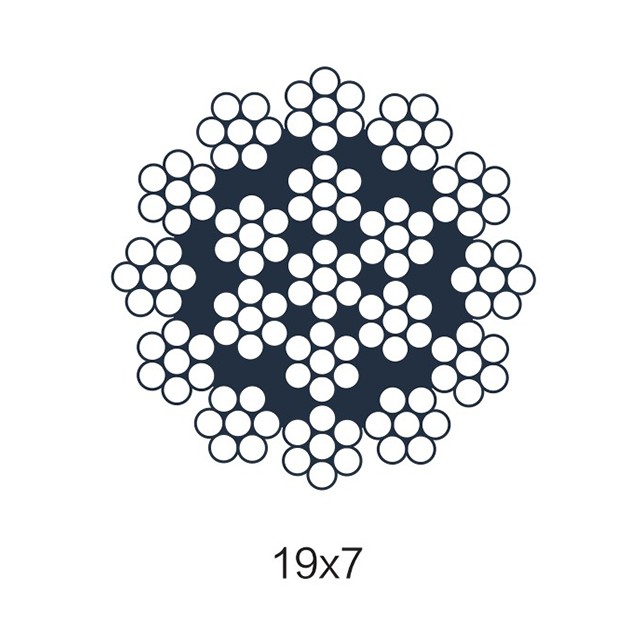
19x7 |
Nominal
Diameter
(mm) | Approx Weight(kg/100m) | Nominal Tensile Strength(MPa) |
| 1770 | 1960 |
| Minimum Breaking Strength(kn) |
| FC | IWRC | FC | IWRC | FC | IWRC |
| 4 | 6.12 | 6.43 | 8.8 | 9.29 | 9.7 | 10.3 |
| 5 | 9.57 | 10 | 13.8 | 14.5 | 15.2 | 16 |
| 6 | 13.8 | 14.5 | 19.8 | 20.9 | 21.9 | 23.1 |
| 7 | 18.8 | 19.7 | 26.9 | 28.5 | 29.8 | 31.5 |
| 8 | 24.5 | 25.7 | 35.1 | 37.2 | 38.9 | 41.1 |
| 9 | 31 | 32.6 | 44.4 | 47 | 49.2 | 52.1 |
| 10 | 38.3 | 40.2 | 54.9 | 58.1 | 60.8 | 64.3 |
| 11 | 46.3 | 48.6 | 66.4 | 70.3 | 73.5 | 77.8 |
| 12 | 55.1 | 57.9 | 79 | 83.6 | 87.5 | 92.6 |
| 13 | 64.7 | 67.9 | 92.7 | 98.1 | 103 | 109 |
| 14 | 75 | 78.8 | 108 | 114 | 119 | 126 |
| 16 | 98 | 103 | 140 | 149 | 156 | 165 |
| 18 | 124 | 130 | 178 | 188 | 197 | 208 |
| 20 | 153 | 161 | 219 | 232 | 243 | 257 |
| 22 | 185 | 195 | 266 | 281 | 294 | 311 |
| 24 | 220 | 231 | 316 | 335 | 350 | 370 |
| 26 | 259 | 272 | 371 | 393 | 411 | 435 |
| Note: Stainless Steel Wire Rope is available. |
Standard: GB/T20118-2017
For various equipment of lifting, hoisting and dragging, the rope with steel core may be used under the shock load, heated and squeezed condtion.
Product Overview
This design leverages opposing twist directions between inner and outer strands to neutralize torque, making it the ideal choice for lifting applications where load stability is critical. Unlike conventional wire ropes that can spin dangerously when hoisting heavy loads, the 19×7 configuration maintains exceptional stability even during sudden load changes. Its unique balance of flexibility, strength, and rotational control has established it as a benchmark in industries ranging from construction to marine operations.
Product Features
Torque-Neutral Design
The defining characteristic of the 19x7 rope is its ability to minimize rotation through strand twist compensation. By engineering inner strands with a opposite lay direction to outer strands, the rope achieves near-zero torque under full load—a critical safety feature for crane operations and precision lifting.
High Tensile Performance
Constructed from high-quality carbon steel wires, this rope delivers impressive tensile strength ranging from 1570 MPa to 2160 MPa. For a 20mm diameter rope, minimum breaking loads reach 408 kN at 1960 MPa, providing substantial safety margins for heavy-duty applications. The 19-strand configuration ensures efficient load distribution across the rope's cross-section.
Smooth Operation
The rope's compact construction creates a smooth outer surface that reduces friction against sheaves and drums. This feature not only extends the service life of both the rope and associated equipment but also contributes to quieter operation—a valuable attribute in urban construction environments and indoor facilities.
Corrosion Resistance Options
Available in both bright (uncoated) and galvanized finishes, the 19x7 rope can be tailored to environmental conditions. Galvanized versions provide enhanced protection against moisture and chemical exposure, making them suitable for marine, offshore, and outdoor applications where corrosion resistance is paramount.
Applications
The 19x7 Non-rotating Steel Rope excels in demanding lifting scenarios:
• Tower cranes and crawler cranes where load stability prevents dangerous swing during lifts
• Elevator and lift systems requiring precise positioning and minimal vibration
• Marine and offshore operations including ship-to-shore cargo handling and offshore platform lifts
• Mining applications such as shaft hoisting and ore container transport
• Construction projects involving heavy component placement with tight tolerances
FAQ
What makes the 19x7 rope non-rotating compared to other constructions?
The non-rotating property stems from its balanced strand lay design, where inner strands twist in the opposite direction to outer strands. This creates torque cancellation when the rope is under tension, eliminating the rotational forces common in conventional ropes.
How does diameter affect rotational resistance?
While all 19x7 ropes maintain non-rotating characteristics, larger diameters (16mm and above) exhibit enhanced torque resistance due to increased strand interaction. Smaller diameters offer greater flexibility for applications requiring frequent bending over sheaves.
What is the recommended maximum operating temperature?
For standard carbon steel versions, the maximum continuous operating temperature is 100°C (212°F). For high-temperature applications up to 200°C (392°F), specialized heat-resistant lubricants and construction are available.
How does this rope compare to 8-strand ropes in terms of flexibility?
While 8-strand ropes offer good flexibility, the 19x7 design provides superior rotational stability at the cost of slightly reduced bending flexibility. The 19x7 rope requires a larger minimum sheave diameter (typically 25x rope diameter) compared to 8-strand constructions.
What inspection criteria should be followed for 19x7 ropes?
Key inspection points include checking for strand distortion, which indicates torque imbalance, as well as wire breaks, corrosion, and diameter reduction. Any visible distortion or more than 6 wire breaks in a 6d length (where d is rope diameter) requires immediate removal from service.


